Showing posts with label almanac. Show all posts

Sunday, 9 February 2025

A chart showing the auspiciousness of the 28 Lunar Mansions 二十八宿吉凶定居图: Chinese electional astrology

In this post I shall translate a short Chinese electional astrology text on the "Lunar mansions" or Xiu. It comes from the 2018 edn of the 集福堂 “Hall of collected fortune" almanac of China. This post was based on a twitter thread I published in 2021 https://x.com/edwardW2/status/1435541551598342146/


There are many such texts that are currently circulating in Chinese almanacs. They vary in form and content; some are 4 lines of 7-character verse; others have 8 lines of verse. per lunar mansion This particular poem. however is particularly concise- each judgment merely 12 characters long. Hence it is a ripe candidate for translation.

As some of my readers are no doubt aware, these Xiu 宿 are Chinese constellations. However, we are not concerned with these constellations today, but rather with their current use: as a cycle of 28 days that has no relation to the moon's position in the sky whatsoever. (Think of it as a 28-day week) Chinese almanacs tabulate what is the Xiu or lunar mansion assigned to a particular day. For example, the day I type this (10 Feb 2025) is assigned to the Xiu 心- heart, the 5th lunar mansion. Reading the relevant poem, we find it is an inauspicious day to marry or build. Tomorrow, by contrast will be assigned the 6th lunar mansion, Wei the tail. This is a propitious day to build or bury, as it brings officials.

Each Xiu is associated with an animal. I have taken the translations of the animal names from Thomas Thomas F. Aylward's _The Imperial Guide to Feng Shui and Chinese Astrology (his translation of 協記[辦方書)


which is one of the very few good books on Chinese astrology in English. Each entry of this text is headed with a small drawing of the relevant animal, which adds much to its charm.

Again, you might notice that each of the names of the xiu are associated with a planet/ one of the 5 phases. When the xiu are used in practise, each xiu lines up one of the seven days of the week; so, all the xiu assigned to the "sun"in them fall on Sundays; all the xiu with the word "Fire" on them fall on Tuesdays (as Tuesday- Mars day (martidi) - 火曜日)

As regards the categories of elections, the categories that are mentioned almost invariably in each entry are burial, marriage and construction- things which are in generally the preoccupation of Chinese electional astrology.

Some entries need a bit more explaining, such as mentions of “Doors” and “Water”. Doors, refers to auspicious days to fix/repair doors. “Releasing Water” I gather, surrounds opening irrigation ditches and suchlike works.Finally, as regards to the caveat attached at the end of the whole text, what the book is referring to is a rather complex form of divination called the "Evolving beasts" 演禽術, which somewhat resembles Greater Six Ren 大六壬 divination

Some other almanacs, like the Hong Kong 廣經堂 - Hall of Broad Classics almanac express an even more extreme skepticism about the lunar mansions:


值於舊曆書內所載之二十八宿,原為西城人士紀曆之用,本無吉凶之分,玉匣記附以吉凶詩斷,協記己闢非,今仍註於六甲子日之下者,實為保留紀曆作用,對星宿吉凶論斷,實毋需重視也。
"in the old calendars, were recorded the 28 mansions . These were originally used by the people of the Western Lands to record time, and originally were not divided into auspicious or inauspicious [xiu]. The Jade Box Record 玉匣記, has an appendix which contain poems judging the auspiciousness of each of the xiu; however The Imperial Guide to Feng Shui and Chinese Astrology has shown why [these poems] are baseless 闢非. These lunar mansions are placed beneath the 60 Stems and branches (in this almanac), for the sake of preserving their calendarical use. As for their [in]auspiciousness, in truth, one should put much stock by them.


Thursday, 30 September 2021

Questions and Answers with Confucius 孔子問答

 In this post, I will post a bilingual edition of a curious Chinese text about Confucius. Entitled 孔子問答, - Questions and Answers with Confucius, also called 小兒論- Discussions with a child -- it shows how Confucius is is first matched, then flummoxed by a  boy called Xiang Tuo.項橐 It is reprinted yearly in Chinese almanacs.

His story was mentioned as early as in the Stratagems of the Warring states, https://jenniferdodgson.wixsite.com/warringstates/qinwang2 , but the actual interactions, we are told, was lost. The text translated here is probably an apocryphal text that fitted into this story. Xiang Tuo also has a baidu article (In Chinese  https://baike.baidu.com/item/%E9%A1%B9%E6%A9%90/3121539 )


One of the segments of the Stratagems In which Xiang Tuo (or, as he is called, Xiang Gao) is mentioned


Only one translation has been made of this text, which is found in Martin Palmer et, al's T'ung Shu (Vinpress, 1990),. However, this translation is also flawed-- and indeed, leaves out an entire segment of the text. The author thus reproduces Palmer's translation here, correcting it as necessary, and supplying the missing parts. 


.  

.  
These images are the text as shown in the 廣經堂 Guang jing Tang Almanac for 2020. The actual text translated is in the bottom half of the page. The top half of every page except the first is occupied with a list of Confucius' disciples, and has nothing to do with the bottom "Q&A with Confucius" text, except, perhaps, in theme, 

Friday, 11 December 2020

A panopoly of Chinese amulets

This post has been derived from a tweetstorm I published on my twitter, @edwardW2, 

1/ A set of amulets for many purposes from the 2018 ed of the 繼成堂 (Hall of Continuing accomplishments)  almanac, published in China


Preface (Text marked A) in bottom left

符咒是我国几千年的民族传统文化之一,但并非每个人画符都能,应验,有绿者必须心清意静,意念高度集中才能达到画符的目的
Amulets are part one of the ancient culture of our country. But not every person is capable of drawing an effective amulet. Those who are fated to have this property, should with clear heart and still intent. Only through a high concentration of the will, may the amulet have the desired effect. 


There are 15 amulets on the page. Each of them resolves a particular evil. The work describes the various materials on which the amulets are to be written on: 


1. Makes business prosper; carry about the person. Write in black ink on red paper

2. Increases money luck; carry about the person. Write in Cinnabar ink 硃 on red paper. 

3. Use this this if children are hard to rear 難養. The central inscription has space for which to write the child's Year, Mth, day and Hour of birth on. 


4. For harmony between man & wife. Write this with Cinnabar ink on Yellow paper. Burn to ash and stir into the partie's drink, but do not let the two parties know of this.

5. Protects the foetus and the Mother. This amulet is especially valuable if mother has offended the foetal god;胎神, in which case, burn to ash, dissolve it in water and give it to the pregnant woman to drink. Mother and child will be safe.

6. for a rather distressing condition called 收惊 Shoujing,  baike.baidu.com/item/%E6%94%B6, where the child grows ill after a fright (said to be of supernatural origin)

7. Amulet to dissolve bones; said bones are ones accidentally swallowed and stuck in the throat. It is to be written using black ink on a piece of flowered writing paper; 花笺. A spell is written besides it, namely" 

赫赫陽陽,奉請三山九候,此碗化為江洋大海咽喉化萬丈深潭,全力吞入變化無出
"Brightly, Brightly, Yang, Yang, I humbly ask the Nine Dukes of the Three Mountains, to transform the water into this dish into that of rivers in seas; to transform it into a sea, to transform the gullet into a lake a thousand fathoms deep, to swallow [the bone] with all effort, and transform it so it disappears"

( I presume you burn the paper, recite the spell , stir ashes into water, & swallow the water.) 

8. To dispel evil forces that one has offended 退煞冲丧犯. Write using Cinnabar ink on yellow paper; burn and drink the ashes in water 

9. To resolve quarrels between father & son (make 2 copies of the amulet, one to be carried by each party)

10. To suppress bad dreams. Write with red ink on yellow paper, and carry on body

11. To stop bleeding and cure small wounds. The text adds the following instructions. 

注:轻微皮肤伤或刀伤、在条件不便时可用绿色树叶(无毒)一片,用指箭画一直,边念;一二三四五,金木水火土、余仿此,正面朝外贴于伤处。 
Note: For a gentle cut or scratch, when nothing else can be had, take a green, leaf of a tree (so long as the leaf is not toxic) and trace out the amulet [shown above] with the fingers; whilst doing so say one, two, three, four five, Metal, Wood, Water, Fire, Earth,  Then paste it, with the writing side towards the wound.

12. To avoid quarrels and contentions. Write using red ink on red paper; carry on body. 

13. Amulet to repay debts. Write it in black ink on yellow paper; write the reason for the debt on the back. 

You are to write your name in the place of the crosses on the right and the date and time of birth on the dots below. The line on the left is for you to write your address; the Chinese  words there translate to "Address: People's republic of China, ____ Province, ___ " I presume if you are not in the PRC, you replace this line with your own address and country.

14. For “protecting the body" 保身. To be written in Cinnabar red ink on yellow paper, and carried about the person

15. For  protecting the body whilst travelling.To be written in red ink on yellow paper, and carried about the person.

Thursday, 17 September 2020

A Chinese ritual guide from the "Hall of Collected treasures" almanac : Part 3, Theurgy

  This is a translation of a ritual guide from the "Hall of Collected treasures" 聚寶樓, Ju bao lou almanac, published in Guangdong.廣東省江門土産進出口有限公司出品 .

This ritual guide provides a fairly detailed overview of aspects of Chinese ritual culture. The guide in its original form is 16 pages long, each page split into two rows, one above the other

In the following translation,  these breaks have been noted; the top row will be called A, and the bottom row, row B. So, [2A] refers to the top row of page 2 etc. 

To make this translation more useable, I have split it into three parts, viz:

1) Making wishes and thanking the gods 
2) Rituals of the new year
3) Worshipping specific gods. <This one>


In this section are found rituals for worshipping various gods, which would be of interest to both practitioner and anthropologist alike. here, we shall find..

- Worshipping Taisui,or the Grand Duke; basically a remedial astrological ritual
- Guanyin opening her stores: A form of religiously-reglated community finance 
- Che Kung and Wong Tai Sin, the two main deities of Hong Kong, along with copious instructions when visiting their temples
- How to consult the Lot-oracle that often is found in temples. 

A Chinese ritual guide from the "Hall of Collected treasures" almanac : Part 2

  This is a translation of a ritual guide from the "Hall of Collected treasures" 聚寶樓, Ju bao lou almanac, published in Guangdong.廣東省江門土産進出口有限公司出品 .

This ritual guide provides a fairly detailed overview of aspects of Chinese ritual culture. The guide in its original form is 16 pages long, each page split into two rows, one above the other

In the following translation,  these breaks have been noted; the top row will be called A, and the bottom row, row B. So, [2A] refers to the top row of page 2 etc. 

To make this translation more useable, I have split it into three parts, viz:

1) Making wishes and thanking the gods 
2) Rituals of the new year <This one> 
3) Worshipping specific gods. 

In this section, are found the instructions for several rituals carried out immediately before Chinese New Year, and shortly after it. We find the homely ritual of Thanking the stove [in which a god is basically bribed!] , the ritual spring-clean before new year, and finally re-opening shops on an auspicious day. 

A Chinese ritual guide from the "Hall of Collected treasures" almanac : Part 1, Making wishes and giving thanks.

 This is a translation of a ritual guide from the "Hall of Collected treasures" 聚寶樓, Ju bao lou almanac, published in Guangdong.廣東省江門土産進出口有限公司出品 .

This ritual guide provides a fairly detailed overview of aspects of Chinese ritual culture. The guide in its original form is 16 pages long, each page split into two rows, one above the other

In the following translation,  these breaks have been noted; the top row will be called A, and the bottom row, row B. So, [2A] refers to the top row of page 2 etc. 

To make this translation more useable, I have split it into three parts, viz:

1) Making wishes and thanking the gods <This one>
2) Rituals of the new year
3) Worshipping specific gods. 

Here is a sample of the original text: 

*** *** ***
In brief, this section teaches the most basic of rituals: making wishes or petitions to the gods, and also the rituals for giving thanks to them. It shows the basic outline of rituals, such as the necessary offerings, etc that are vital context for the 2 other sections. 

Thursday, 23 July 2020

Raphael's ephemeris Part 1, the Daily pages.

Part 1: Raphael’s  Ephemeris

In this post I will be talking about the major English- language almanacs. I will start with one of the most extraordinary  ones: Raphael's ephemeris. For lack of a better word, this ephemeris is a complete anachronism. Almanacs with a similar format have been published since the 18th century. But because of this, Raphael's ephemeris is extraordinarily  suited for astrological work-- even more so than almost every other ephemeris.

1. The Monthly pages 

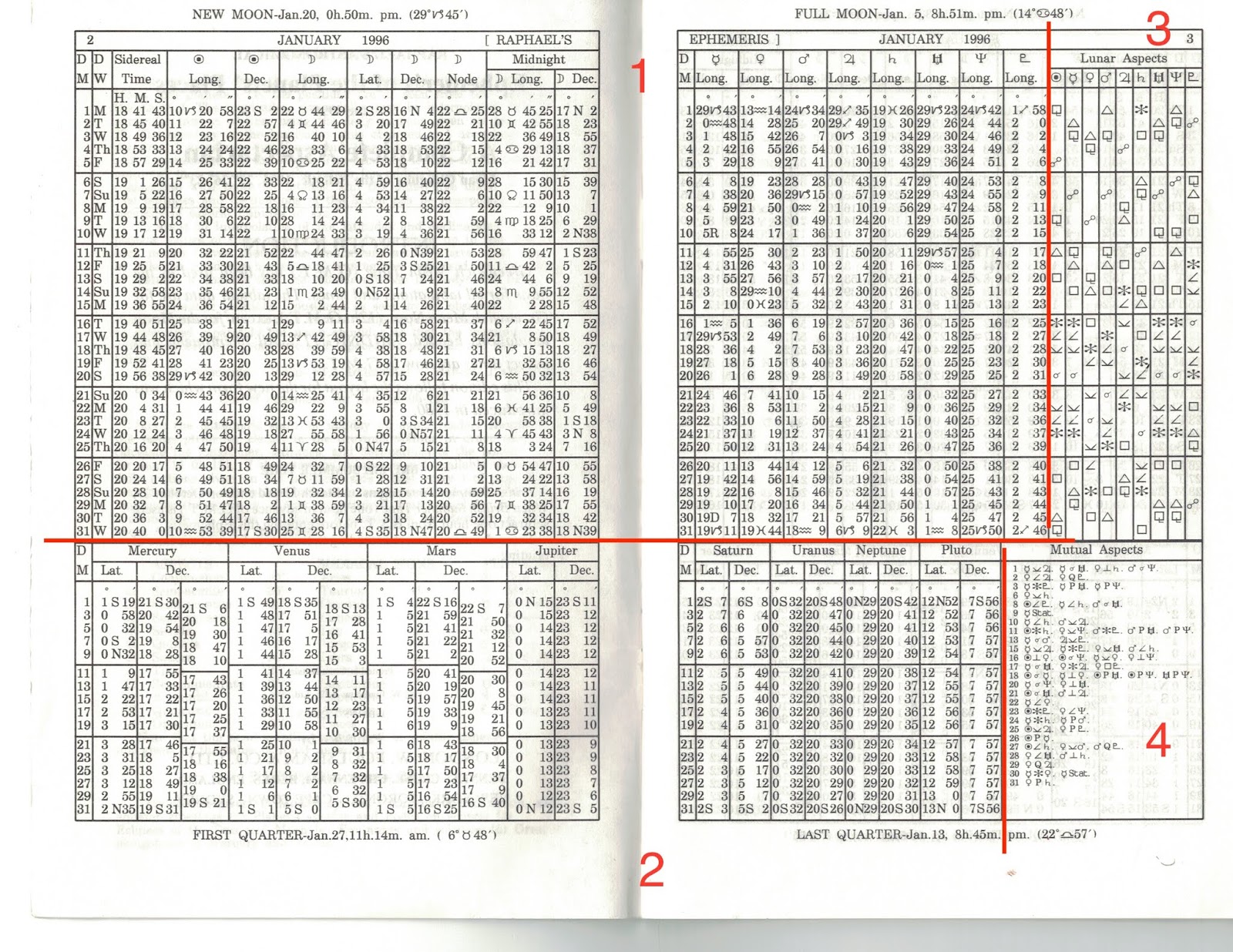
Two pages are dedicated for the planetary positions for each month. Here is the two-page spread, for of Jan 1996. The format is identical to the ones used today.


Each page can be divided into four sectors (see above) . In Sectors 1 and 2  we find the planet's positions. Sectors 3 and 4 show astrologically significant configurations of the planets.

Sector 1:

This contains planetary coordinates. The Left-hand page gives the following things, in order

  1. The Day of the month
  2. The Day of the week, both of which are self-explanatory
  3. The Sidereal Time: This is a measure of the earth's rotation. It is used to calculate house cusps. 
  4. The Sun's Longitude: This is the position of the sun in the Ecliptic, the  path the sun traces through the sky each year. For more on this, see http://www.medievalastrologyguide.com/the-zodiacs.html
  5. The Sun's Declination: This is how far above or below the sun is above the celestial equator. which is an imaginary band in the sky, used by astronomers as part of their coordinate system. 
  6. The Moon's Longitude: the position of the Moon in the Zodiac, 
  7. The Moon's [ecliptic] Latitude: This is how far above or how far below the Moon is from the Ecliptic. (BTW, The sun  has no ecliptic latitude, for he always travels on the ecliptic itself, never above or below it!)
  8. The Moon's Declination-- Like [5] but involving the moon
  9. The Moon's Node-- (The North Node) One of the points where the moon's path crosses the ecliptic. This is known as Rahu to the Indian astrologers, or Luohou 羅睺 To the Chinese.  It is astrologically significant point. The other point where the Moon's path crosses the ecliptic is the South node. This is always 180 degrees opposite the North Node; as a result there is no need to waste space with another column.
  10. The Moon's Logitude at 24H
  11. The Moon's Declination at 24H
These planetary positions are for GMT 1200H  every day. The exception are columns 10 and 11. These refer to the positions at "24h" each day, or in more normal terms, midnight the next day. For example, column 6 tells us the moon was in 22 Taurus on Midday 1 Jan. Column 10 tells us that 12 hours later -- i.e. midnight on the 2nd of January, she had moved to 2

 For an explication of ecliptic longitude, see: http://www.medievalastrologyguide.com/the-zodiacs.html

Reading that is fairly simple. So, we find the Sun's Longitude on Midday, New Year's day 1996 was 10 ♑(Capricorn) 20 (280°20' if you are using absolute Longitude like astronomers) and his declination was just over 23 degrees South. The Moon's Longitude was 22 ♉(Taurus)  40 (=52°40' if you are using absolute Longitude). 

Readers should note Raphael's ephemeris uses the tropical, rather than the Sidereal zodiac. However, if I recall correctly, their 50-year ephemeris  tabulates the ayanamsa each month. 

The exact method of converting between absolute longitude and longitude in terms of signs  is as follows: The whole ecliptic was divided into 12 equally-sized segments of 30 degrees each. Each of them is called a Sign.   


Symbol
Name
Absolute Longitude 
From
To
Aries
0
29
Taurus
30
59
Gemini
60
89
Cancer
90
119
Leo
120
149
Virgo
150
179
Libra
180
209
Scorpio
210
239
Sagittarius
240
269
Capricorn
270
299
Aquarius
300
229
Pisces
330
399

To use this table, add the degrees you see in the 'from' column to the minutes, and the result is absolute longitude. The converse is also true. 

So, for example, a planet that had a longtitude of 65°20'  would be expressed as   5°20'. i.e. (2 x 30) + 5°20'.

However, it is now more common to place the sign's symbol between the degrees and minutes parts, thus:  5 20, or 5 Gem 20, if you are in a text format. 

To give another example: Venus' Longtitude was 13 14. This means it was in 13 degrees 14 minutes of Pisces. 

Absolute longditude of Pisces
330°00’
Add the number of degrees
  13°14’
Sum , or absolute longditude:
342°14’


The process can also be reversed.  So, for example, what is the position in terms of signs of a planet that has the longtitude of 109°45'?

1) 109 degrees falls within Cancer, (as cancer refers to a long. between 90 and 119°)
The given Longitude 
109°45'
Minus, the longitude of start of cancer: 
  90°00
The position within Cancer itself 
19°45'

Thus 109°45'?  corresponds to 19 45
A full tabulation  of correspondences can be found here: https://www.skyscript.co.uk/ablong.html 


***
I must stress that these 12 divisions have nothing to do with the constellations they have named after. They are wholly imaginary divisions of the ecliptic. For example, Spica, a star in the Constellation Virgo, has the ecliptic longitude of around 203 degrees-- which places it in the Sign of Libra.  

You may think this sounds absurd. Sidereal  astrologers would agree with you. these astrologers  'correct' to the ecliptic longitude, so the signs and constellations more closely correspond. I would outline this process in a later post. 

 On the other hand, some would argue that the 'correction' is unnecessary : There are legitimate astrological and astronomical reasons for using them. I will give one briefly. When the Sun is in the sign of Aries and Libra, the days and nights are of roughly equal length. The Sun in Capricorn would bring the longest nights of the year, and the Sun in Cancer would bring the shortest nights of the year (for the northern hemisphere at least. The Southern hemisphere, Cancer brings the longest nights and Capricorn the shortest) This correspondence is much distorted when you use the sidereal  zodiac. 

For more on this subject see http://www.medievalastrologyguide.com/the-zodiacs.html


***

Why are the planet's positions are charted for Midday rather than Midnight?  This harks back to the the 19th century. Back then, astronomers counted the day as starting from midday, rather than from midnight. Although astronomers switched to using Midnight [around 1925] the makers of the almanac retain the old system, perhaps through habit.

*** *** ***

Sector 2 shows the planet's latitude and Declination for the planets apart from the Sun and the Moon. In old editions of the almanac, Sector 2 is placed above the longitudes.


Latitude is the vertical distance from the Ecliptic; Declination the vertical distance from the equator.. Since the Sun travels exactly on the ecliptic (The ecliptic is by definition the Sun's path), it has no latitude, and is hence not tabulated. The Sun's declination is already tabulated in Sector 1, along with the Moon's latitude and declination.

For Jupiter, Saturn, Uranus, Neptune & Pluto, the declinations are calculated for every second day of the month. But for Mercury, Venus, and Mars, they are calculated for every day of the month.
The declinations for the three planets arranged in a curious manner. The declinations are split into two columns, which are staggered. The odd-numbered days are placed in one column; the even-numbered days are placed in a second column, with staggered lines.

So, Mercury's declination was
21°30' south on Jan 1st  (1st col. 1st row)
21
°06'  south on Jan 2nd (2nd col headed 'dec' 1st row)
20°42'  south on Jan 3rd (2nd col. 1st row)
etc etc etc 


*** *** *** 
Sector 3 shows the lunar aspects. This is the unique feature of the almanac. Raphael's is the only almanac that displays such data in a user-friendly manner.  So, for example, on January 1st we find that the Moon made a trine to Mars and Neptune, a Sextile to Saturn, and a sesquiquadrate (135 degrees) with the Sun.  Searching for aspects is also equally easy. If you wanted to find 'moon conjunct Jupiter' you run your finger down the column headed ""(= Jupiter)  until you get to the symbol for conjunction. () (In this case the conjunction occurred on 18th Jan.) This is useful because Lunar aspects were traditionally used in selecting auspicious times for things.

Sector 4 the mutual aspects. Under this section are found aspects between the planets, as well as retrograde/direct stations.


So much for the planetary positions. However, what occurs after the planetary positions is more interesting; it will be added in a subsequent blog post