Showing posts with label chinese. Show all posts

Friday, 11 December 2020

A panopoly of Chinese amulets

This post has been derived from a tweetstorm I published on my twitter, @edwardW2, 

1/ A set of amulets for many purposes from the 2018 ed of the 繼成堂 (Hall of Continuing accomplishments)  almanac, published in China


Preface (Text marked A) in bottom left

符咒是我国几千年的民族传统文化之一,但并非每个人画符都能,应验,有绿者必须心清意静,意念高度集中才能达到画符的目的
Amulets are part one of the ancient culture of our country. But not every person is capable of drawing an effective amulet. Those who are fated to have this property, should with clear heart and still intent. Only through a high concentration of the will, may the amulet have the desired effect. 


There are 15 amulets on the page. Each of them resolves a particular evil. The work describes the various materials on which the amulets are to be written on: 


1. Makes business prosper; carry about the person. Write in black ink on red paper

2. Increases money luck; carry about the person. Write in Cinnabar ink 硃 on red paper. 

3. Use this this if children are hard to rear 難養. The central inscription has space for which to write the child's Year, Mth, day and Hour of birth on. 


4. For harmony between man & wife. Write this with Cinnabar ink on Yellow paper. Burn to ash and stir into the partie's drink, but do not let the two parties know of this.

5. Protects the foetus and the Mother. This amulet is especially valuable if mother has offended the foetal god;胎神, in which case, burn to ash, dissolve it in water and give it to the pregnant woman to drink. Mother and child will be safe.

6. for a rather distressing condition called 收惊 Shoujing,  baike.baidu.com/item/%E6%94%B6, where the child grows ill after a fright (said to be of supernatural origin)

7. Amulet to dissolve bones; said bones are ones accidentally swallowed and stuck in the throat. It is to be written using black ink on a piece of flowered writing paper; 花笺. A spell is written besides it, namely" 

赫赫陽陽,奉請三山九候,此碗化為江洋大海咽喉化萬丈深潭,全力吞入變化無出
"Brightly, Brightly, Yang, Yang, I humbly ask the Nine Dukes of the Three Mountains, to transform the water into this dish into that of rivers in seas; to transform it into a sea, to transform the gullet into a lake a thousand fathoms deep, to swallow [the bone] with all effort, and transform it so it disappears"

( I presume you burn the paper, recite the spell , stir ashes into water, & swallow the water.) 

8. To dispel evil forces that one has offended 退煞冲丧犯. Write using Cinnabar ink on yellow paper; burn and drink the ashes in water 

9. To resolve quarrels between father & son (make 2 copies of the amulet, one to be carried by each party)

10. To suppress bad dreams. Write with red ink on yellow paper, and carry on body

11. To stop bleeding and cure small wounds. The text adds the following instructions. 

注:轻微皮肤伤或刀伤、在条件不便时可用绿色树叶(无毒)一片,用指箭画一直,边念;一二三四五,金木水火土、余仿此,正面朝外贴于伤处。 
Note: For a gentle cut or scratch, when nothing else can be had, take a green, leaf of a tree (so long as the leaf is not toxic) and trace out the amulet [shown above] with the fingers; whilst doing so say one, two, three, four five, Metal, Wood, Water, Fire, Earth,  Then paste it, with the writing side towards the wound.

12. To avoid quarrels and contentions. Write using red ink on red paper; carry on body. 

13. Amulet to repay debts. Write it in black ink on yellow paper; write the reason for the debt on the back. 

You are to write your name in the place of the crosses on the right and the date and time of birth on the dots below. The line on the left is for you to write your address; the Chinese  words there translate to "Address: People's republic of China, ____ Province, ___ " I presume if you are not in the PRC, you replace this line with your own address and country.

14. For “protecting the body" 保身. To be written in Cinnabar red ink on yellow paper, and carried about the person

15. For  protecting the body whilst travelling.To be written in red ink on yellow paper, and carried about the person.

Friday, 6 November 2020

高王觀音經 The High King Avalokitesvara Sutra – A bilingual edition

 高王觀音經

THE HIGH KING AVALOKITESVARA (GUAN YIN) SUTRA –

A bilingual edition


This scripture is quite widely spread in China, but is seldom discussed in the west. Continuing in my series of bilingual editions, I have reproduced it here. 


The Chinese text of this edition is Taisho tripitaka No. 2928; It is accessible here 

http://tripitaka.cbeta.org/T85n2898_001 


The "Original preface" to the sutra-- which shows how the scripture was revealed to the mortal world is translated here: https://edwardwhite123.blogspot.com/2021/05/the-original-preface-to-high-king.html  In brief, a person wrongly accused of a capital offence had a dream-vision, wherein a monk revealed this Scripture to him. After chanting it a thousand times, the executioner's sword shattered to pieces, saving him. The astonished king who sentenced him to death freed him, and ordered the sutra to be promulgated. 


However, it is precisely because of this revelation, that some buddhists consider it to be an apocryphal sutra偽經. The Taisho Tripitaka puts it under "doubtful sutras 疑似" . For more on this subject  see this post https://edwardwhite123.blogspot.com/2021/10/the-high-king-guanyin-sutra-as.html


Despite these doubts, this sutra was fairly popular in China, as can be evidenced by the numerous editions of this text-- and indeed, one translation into the now-extinct Tangut language. Links to copies of the old sutra will be given at the end of this introduction. 

*** *** *** 


I shall feature two translations of this sutra. Both of them are anonymous. The first translation, which I shall call translation A, can be accessed here: 

http://tbsn.org/english2/sutra.php?id=4&keyword=&page=0 

This translation is bilingual.  the Chinese being placed there in pinyin (printed in CAPITALS). This translation is here printed in blue. 


The second, equally anonymous translation I shall call translation B. It  is accessible here https://www.fodian.net/world/2898.html . It is printed in black. 


*** *** *** 

 Some of these old woodblock editions can be seen here: 


Wednesday, 4 November 2020

關聖帝君覺世真經-- The Sage Therach Guan's true Scripture to Awaken the world: Two English translations

關聖帝君覺世真經

The Sage Therach Guan's true Scripture to Awaken the world. 

Guan Sheng Di Jun world Awakening Prayer 

A true scripture to awaken the world, by the Holy Imperial Prince Kwan-Foo-Tsze

[pic is From the Staatsbiblotek Berlin's Copy of the 關帝明聖真經]

This text is one of a particular example of what are called in Chinese 善書: meritorious books. This text is attributed to Lord Guan, a Chinese general who is venerated as a god. 

The text  is in two parts; the first, which is an introduction and is in prose. The second is in verse-- sentences of three of four characters each. This latter section contains an uncompromising moral code-- do not lie, steal, cheat, or you and your descendants will be destroyed!

This present edition contains three texts: They are the Original Chinese, and two english translations. 

The Chinese text I have got from this site:http://www.boder.idv.tw/ks.htm of which an archive link is: https://web.archive.org/web/20201029085841/http://www.boder.idv.tw/ks.htm 

The older english translation is by Robert Morrison. You can see it here https://books.google.com/books?id=s8JLo8o1Tz0C&pg=PA146#v=onepage&q&f=false

He included it in  Part 3 of his celebrated Chinese-English dictionary. As might be expected from a person of his era, he called it a "Pious fraud" -- that is, he did not believe it was actually written by Lord Guan. However, what Morrison evidently did not object to, was the ethical system contained within. He chose to include it inside his dictionary as a sample of Chinese Ethical beliefs. Morrison's translation is fairly accurate, but is unfortunately incomplete: He only translated the verse section.

The second translation featured is by Andrew Gudgel. It can be found on its original website here:https://web.archive.org/web/20150502063646/http://guanshengdijun.com/GuanShengDiJunWorldAwakeningPrayer.html
And in a copy by a fellow blogger here https://heathenchinese.wordpress.com/guan-sheng-di-jun-prayers/

It is best to leave it to Gudgel to explain how he came to this book:  

"Someone had set out a stack of prayer booklets as a deed of merit, hoping that passersby would take them. Out of curiosity, I took home a booklet. Out of curiosity, I began to translate the prayers. After reading the testimonials, I became afraid to not finish translating them. I leave them here on this electronic street corner for anyone to take. " - Andrew Gudgel

Gudgel's translation differs from Morrison's. He translates the complete text, but does so in a more concise, proassic manner. His online edition reproduces several miracle tales surrounding the scripture--  what he calls "testimonials" a common thing for Chinese scriptures.  However, as I cannot  locate the Chinese originals of these miracle tales, I will not be featuring them here. 

One particular piece of trouble comes the fact of variant texts. Like most Chinese books, there are many small differences between editions of the same text -- sentences added, omitted or rearranged, otherwise different characters used. 

With the  Morrison text, detecting variants with the online is easy enough, because he printed the Chinese text alongside it. With Gudgel's text, this is a more difficult task, as no chinese text is included. 

Judging from the translation, though, Gudgel evidently used a text that was slightly different from both the Morrison and Online ones. The differences get particularly large about section 21-22 of the Verse section. Here it seems Gudgel and Morrison were using sources that had slight variations in the order of the lines. In turn, how many of the variants in Gudgel are simply Gudgel's translation choices, I know not. 

I have set Gudgel's translation in common type, and Morrison's translation in italic. 

Friday, 18 September 2020

Ancestor Peng's Hundred Prohibitions 彭祖白忌

I republish this post from my twitter account, @edwardW2. It was originally published on Mar. 20th 2020: The numbers followed by a slash are the paragraphs of the original tweet, and are retained for reference.

1/ I will now translate a short text of Chinese Eectional astrology, the Pengzu Bai ji = 彭祖百忌, "Ancestor Peng's hundred prohibitions" This is possibly the simplest text of Chinese Electional astrology there is, but AFAIK has never been translated into English.

2/ This text shows the inauspicious activities for each of the ten heavenly stems and twelve earthly branches; 'tis no more complex than electing using the day of the week. The present version was derived from https://baike.baidu.com/item/%E5%BD%AD%E7%A5%96%E7%99%BE%E5%BF%8C
, but agrees with most printed sources.

___The text and its translation____

3/Jia: Yang Wood
甲不開倉,財物耗亡;
Do not open a storeroom on Jia; Wealth and objects will be lost

4/ Yi: Yin Wood
乙不栽植,千株不長;
Do not plant on Yi; No plants will grow

5/ Bing: Yang Fire
丙不修灶,必見灾殃;
Do not build a stove on Bing; It would invite disaster

6/ Ding: Yin Fire
丁不剃頭,頭主生瘡;
Do not shave the head on Ding; It would cause boils on the head

7/ Xu: Yang Earth
戊不受田,田主不祥;
Do not receive land on Xu. It is inauspicious for the owner.

8/ Ji: Yin Earth
己不破券,二比并亡;
Do not make agreements on Ji , Neither side would benefit.
Note: Some sources such as wenku.baidu.com/view/7733b1c48… interpret this to mean all trading is unsuitable.

9a/Geng: Yang Metal
庚不經絡,織機虛張
Do not meddle with the meridians on Geng; The body will be harmed.
Note: In simple terms, moxibustion, & other traditional Chinese medical treatments that interfere with the body’s meridians (energy channels) should not be done on Geng, for fear of damaging the organs. 

9b/ The literal translation of this line is Do not Warp and weft on Geng; the loom will be void; as the term for meridians 經絡 literally refers to the the horizontal & vertical threads in a loom.


10a /Xin: Yin metal
辛不合酱,主人不嘗;
Do not brew on Xin; it would not taste good.

10b/
Xin cont'd
辛不求醫,主人不當
Do not seek a doctor on Xin, It will not bode well for the patent
(this is an Alternate version from a major date-selection compendium "The aspects of Auspiciousness almanac" xiangji tongshu 象吉通書:)

11a/
Ren: Yang Water
1.壬不汲水,更難提防;
(alternate) 2.壬不决水,更難提防;
1. Do not Draw water on Xin, It would be hard to control.
2. Do not Release water on Xin, it would be hard to control.


11b/ Note: The two websites have different interpretations of the phrase. This website  interprets drawing water from a well (the meaning of )as bringing unexpected disasters on yourself...

11c/ Whereas ifreesite.com/calendar/pengz… interprets it as meaning the water would be contaminated.
An alternate version that is sometimes found is (2). This version has instead of . means release or breach; this I interpret as breaching dykes and dams for irrigation.


12/ Gui: Yin Water
癸不詞訟,理弱敌强;
Do not sue on Gui; Your cause will be weak, the opponent’s cause strong.


The section on Earthly branches follows: 


13/ Zi= Rat
子不問卜,自惹祸殃;
Do not divine on Zi. You will get mistaken

14/ Chou: Ox
丑不冠带,主不還鄉;
Do not perform the capping ceremony on chou; the person will not return to the village.
Note: Modern sources say this expands to putting on new clothes of any sort wenku.baidu.com/view/7733b1c48…

15/ Yin: Tiger
寅不祭祀,神鬼不嘗;
Do not pray on yin. The spirts will not get [the offerings].

16/ Mao: Rabbit
卯不穿井,水泉不香;
Do no dig wells on Mao. The water will not be fragrant.

Chen: Dragon
辰不哭泣,必主重喪;
Do not weep on Chen; You will surely weep again.

18/ Si: Snake
巳不遠行,財物伏藏;
Do not travel far on Si; Wealth and objects will elude your grasp.

19/ Wu: Horse
午不苫蓋,屋主更張
Do not cover [a house] with straw on wu. The houseowner will change.
Nb: d1xz.net/rili/jiri/art1… interprets it as a prohibition on all forms of building; if this is ignored, the owner will be forced to sell the dwelling


20/ Wei: Goat
未不服藥,毒氣入肠;
Do not make medicines on Wei; Poisonous Qi will enter the guts.

21/ Shen: Ape
申不安床,鬼祟入房;
Do not position the bed on Shen. Ghosts will haunt the room.

22/ You: Chicken.
酉不宴客,醉坐颠狂;
Do not banquet on You; Drunkenness and madness will result.
22b/ Alternate, from Aspects of Auspiciousness almanac 象吉通書。

22b/ Alternate from【象吉,鰲頭】 酉不出雞,今其耗亡
Do not Let out chickens on You, bad news and death will be received at once.
 Note: This is because You's animal representation is the Chicken.


23/ Xu: Dog
戌不吃犬,作怪上床;
Do not eat dogs on Xu. Ghosts and weird things will ascend to your bed.

Note: This is because Xu has the zodiac sign of the Dog. All the almanacs retain this oddly specific prohibition

24/ Hai: Pig.
亥不嫁娶,不利新郎;
【象吉,鰲頭】亥不出豬,再養難償
Do not marry on Hai; This is bad for the groom.
Alternate, from Aspects of auspiciousness almanac: Do not send out pigs on Hai, it will be hard to rear them onwards.


25/ Background: The Chinese measure time using two cycles, one of ten terms (which represents the 5 “Chinese elements” in their Yin and Yang forms), called the Heavenly stems, and one of 12 terms, which is the familiar chinese zodiac animals.
26/ The 2 cycles run concurrently, so the end result is the combinations of heavenly stems and earthly branches repeat every 60 terms. (for more see en.wikipedia.org/wiki/Sexagenar… )

27/ Now, years, months, days and two-hour periods are all assigned such terms. For the purposes of this text we are looking at the terms associated with the day. If you know the stem and branch associated with each day,
The text shows what you should not do for on that day.

28/ For example, as I type this, today is the day of the Yang Water Dog 壬戌,, the 59th term of the cycle. Looking at the text above, as today has the Heavenly stem of Yang Water, I should not attempt to brew...

29/ In turn, as today has the earthly branch of the Dog, I should also not attempt to eat dogs. [I guess BrewDog beer is doubly forbidden...]

30/ Similarly, As tomorrow is the day of the Yin Water Pig 癸亥, I should also not attempt to sue anyone, or get married

31. As the sexagenary cycle is also used to number hours, some sources say that the prohibitions apply to the hours of the day as well.

32/ If you want to know what is the stem/branch combination for today, there are some twitter handles that give them out. The best is @SeriousFengShui.

33/ But if you look at the stem/branch combination, posted on her feed daily, she does not mention whether the element is yin or yang! Not to worry, there is a way of figuring it out...

34/ If you looked at the sexagenary cycle in full, you will notice something unusual. The odd-numbered Earthly branches (Rat,Tiger,Dragon,Horse,Ape, Dog) will always pair up with the Yang elements...

35/... and the even numbered ones (ox,Rabbit,Snake,goat,Chicken,Pig) will always pair up with Yin elements.

36/ So there is the Yang Wood rat 甲子, Yang fire rat丙子, Yang earth rat戊子, Yang metal rat庚子, and Yang Water rat壬子, but no Yin wood rat 乙子 etc.. Similarly, there is the Yin wood pig 乙亥, and Yin water pigs癸亥, but no Yang wood pig 甲亥, or yang water pig 壬亥.

37 As such, you could deduce the polarity of the element from the “Animal” alone. It follows, specifying that today is the day of the “Yang Wood Rat” is superfluous, as the combination Yin Wood Rat does not exist.

38/ Now, this is the simplest form of Chinese electional astrology. There is, however a more complex form of elections, which involves comparing the day with the month it is in.

39/ The simplest example of which is what is known in the west as the twelve day officers, or the Establish-rid cycle in China 建除, after the first 2 terms in the cycle. Ancestor Peng also has things to say about this cycle, but that is another thread for another time... 

Saturday, 18 July 2020

A Chinese ritual guide

A Chinese Ritual guide –
UPDATE: 17th July 2022-- Parts that had been accidentally left untranslated are now translated. 

The present ritual guide is taken from "The Chinese People's Calendar" 中國民歷,
 Almanac, pub’d by the Starlite book co.新竹林出版社. This ritual guide is broadly divided into two sections, viz, how to position an altar, how to worship the gods, and the rituals for visiting an ancetsral tomb. 

It is hoped that this will prove to be an as it is an interesting compendium of chinese ritual, and custom. 


The original scans are shown below:


Friday, 7 February 2020

Miracle Tales of the Great Compassion Mantra

One rather significant mantra in chinese buddhist practice is the Dabei Zhou 大悲咒, literally the "Great Compassion Mantra". The Chinese tradition links it to Guanyin 觀音, Avalokiteśvara, but research has suggested originally arose as a recitation of the names of Harihara. For that reason, Wikipedia prefers to call the text the Nīlakaṇṭha Dhāraṇī.

Nonetheless, it cannot be denied the Dharani/Mantra has taken a life of its own in China, as the following stories will abundantly attest. When western works mention the mantra, they typically say it is merely recited at funerals. However, as a quick perusal of the stories will show, the Mantra's efficacy is not limited to the salvation of the dead, but also to fire-fighting, saving persons from all kinds of disaster, and perhaps most prominently, the curing of illness. 


***

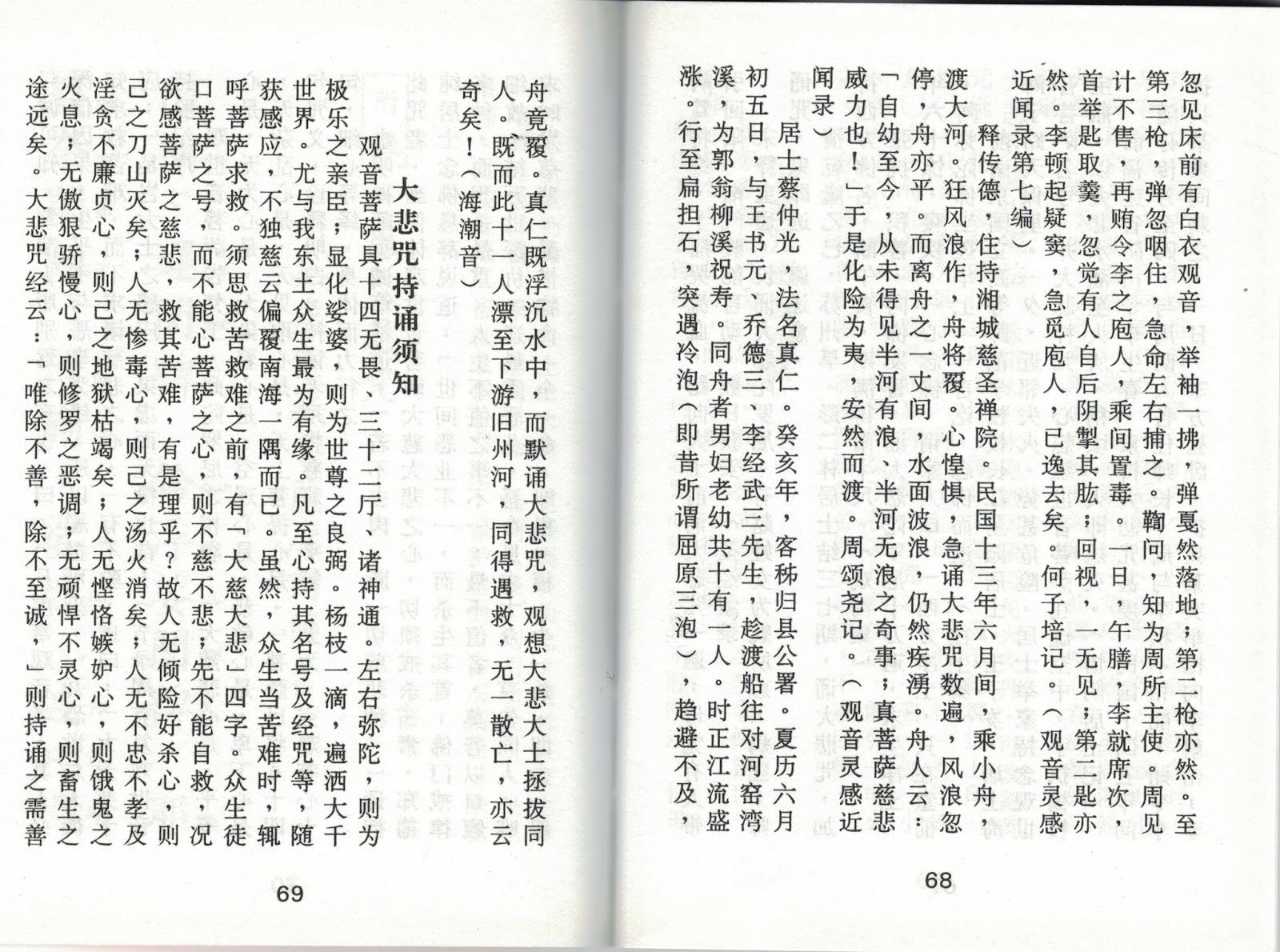
The text is taken form a small pocket-sized booklet. entitled 八十四相大悲咒. Itwas published in Singapore, by Internal Printers 国营印刷, and is freely distributed as a religious tract. Apart form containing the Dabei Zou  it contains several other sutras,  and the present text, which delineates the miracles associated with the sutra.  The present text begins at page 66, of the booklet. Numbers in square brackets indicate the page breaks (in chinese); numbers in Curved brackets indicate footnotes.

Here are scans of the relevant pages.The book reads Right-to-left, in vertical columns. The text translated begins at the red arrow on page 66, and ends on the 3rd column of page 69. For a version of the same text, but in Traditonal Chinese, see https://edwardwhite123.blogspot.com/2019/12/great-compassion-mantra-of-guanyins.html starting on p. 69

UPDATE: The author has now got a copy of a collection of Buddhist sutras published in the "Summer of 1971". https://archive.org/details/buddhistsutracollection_images/page/n20/mode/2up This book contains all the miracle tales translated below  on pages 16-19. As such, we can confidently say all these tales took place before 1971.


Below is the transcription/translation of the tales: 


**** 


[66] 大悲咒感应示略A record of the miraculous effects of the Great Compassion Mantra


清彭希曾妇姚氏,患痞,发心持大悲咒。一夕梦老妪授以一枝华,顿觉身轻如叶,而病寻愈。(一行居集)
During the Qing Dynasty, Ms Peng Xizeng  (maiden name Zao) was afflicted with a tumor. She vowed to recite the Great Compassion Mantra. One night, she dreamed of an old woman carrying a branch of flowers
. Suddenly she felt as if she was as light as a leaf. The illness promptly disappeared (Yixing’s collection)


荆山万文玉自言:「予持大悲咒心经,灵异不胜缕述;忆母[67]病笃将终,予痛哭流血,跽向大士前诵大悲咒一遍;母觉有人带引回阳,渐气暖能言动,数日获安(圣经蒙录)

Wan Wenyu of Jingshan (1) says of himself  “In my (2) opinion, the Great Compassionate Heart Mantra Classic's (3)  numinous efficacy is beyond description. I recall my mother was deathly ill. I wept tears of blood , and knelt before Guanyin (
大士), and recited the Great Compassion Mantra once. My mother felt that someone was leading her back into life. Gradually her breath became warmer, and soon could speak and move. Within a few days she was better again (from the Simple records of the Holy Scriptures )

(1) A place in Hubei
(2) Reading as , which means “I”
(3) The text may actually read “Great Compassion Mantra  and the Heart sutra” i.e two separate texts. Calling the mantra alone the 大悲心咒 is not unheard of, and so I have interpreted his reference to only one text.


宋释宝通,长诵大悲陀罗尼。有赵姓女为魅所惑,病狂;师诵咒,鬼即逃,癫遂愈
Yi Baotong of the Song [dynasty]  had long recited the Great Compassion Dharani. There was a woman, surnamed Yue, who was afflicted by a mei demon, which drove her insane. The master recited the mantra, and the demon fled at once. She was completely healed.


清乾隆乙巳,苏州旱。彭二林居士结三七期,诵大悲咒,加持西方佛名,断午食,期满得雨伴尺(观河集)
In the Wood Snake Year of Qianlong [1785], there was a drought in Suzhou. Peng Erlin, a householder, vowed , for thrice seven days to recite the Great Compassion Mantra. In addition to that, he upheld the name of the Buddha of the west(1), and stopped eating at noon. When the period was up, half a foot of rain fell.  (Collection of Looking at the river)

(1) i.e. Amithaba Buddha.

张抗,积善,向佛发誓,诵大悲陀罗尼十万遍,求生净土。年六十馀,寝疾,一心念佛。谓家人曰:「西方净土,只在堂前;阿弥陀佛坐莲华上。」言讫,念佛而逝 (往生集)
Zhang Kang, cultivated [virtue
]. He made a vow to the Buddha, to recite the Great Compassion Dharani a hundred thousand times, seeking to be reborn in the Pure Land. At the age of sixty-odd years, he contracted an illness, but continued to Nianfo. He told his family “The Pure Land of the West is only just before our hall; Amida Buddha is there, sitting on the Lotus Flower.” After saying that, he Recited the Buddha’s name [once more] and died. (Collection of Coming to Life)


前南京国立高等师范学校校长洪易园居士·壬子岁,居上海海宁里天保里。一夕,近邻失火,势甚危险。居士举家持念观世音菩萨名号,并大悲咒。心想观世音菩萨在虚空中,手执杨枝宝瓶,以大悲水灌至火所。消顷, 火即熄灭。(惜阴居士记)
The former principal of Nanjing Normal School was Hong Yiyuan, a Householder. In the year of the Water Rat (4)  , he was living in Tianbaoli, Haining road in Shanghai. One evening, a neighbour’s [house] caught fire. They were in extreme danger. The Householder gathered his family to recite the Names of the Bodisatva Guanyin ,  to wit the Great Compassion Mantra. They visualised Guanyin in the void, holding a willow branch and a Precious vase [from which] she sprinkled Great Compassion Water into the fire, extinguishing it. The fire went out at once. (Records of the Householder who treasures the Yin)


(4) The year renzi was either 1912 or 1972  The Renzi year referred to was probably 1912. The school was set up in 1915, This story probably happened before he became principal—the next story happens in the 1920s. A “Normal school” refers to a teaching college in China.

前福建省防司令李生春,素持大悲咒甚虔。民国十四五年间,随孙传芳至闽,与周人各任师长。周与李积不相能,贿令李护兵某乘间刺之。一日,李方昼卧,护兵某突举枪向李射击;李[68] 忽见床前有白衣观音,举袖一拂,弹戛然落地;第二枪亦然。至第三枪,枪忽咽住,急命左右捕之。鞫问,知为周所主使。周见计不售,再贿令李之庖人,乘间置毒。一日,午膳,李就席次,手举匙取羹,忽觉有人自后阴掣其肱;回视,一无见;第二匙亦然。李顿起疑窦,急觅庖人,己逸去矣。何子培记 (观音灵感近闻录第七编)
The former commander 防司令 of Fujian, Li Shengchun , sincerely recited the Great Compassion mantra. Around the 14th-15th  year of the Republic (1925-1926), he followed Sun Chuanfang to Min, and commanded a Division, along with Zhou Yinren. (5) Zhou and Li did not get together, and Zhou bribed on of Li’s guards to assassinate him. One day, as Li was taking an afternoon nap, the guard suddenly raised his gun to Li, and fired.  Li suddenly saw, at the foot of his bed, the White Robed Guanyin lifting her sleeve. The bullet promptly clattered to the ground. The same happened with the second and third bullet. The gun suddenly [jammed shut] and assassin was promptly captured. After some investigation, he knew Zhou was the mastermind of all this. But Zhou’s schemes did not end. He bribed Li’s cook to poison Li’s food. One day, Li sat down, taking a midday meal, As he lifted a spoon of broth to his mouth, he felt someone standing behind him, holding his arm back. Li turned around, and saw no one. He lifted up a second spoon, and the same happened. Li became suspicious about the cook, and tried to find the cook at once—but he had fled already. How is it possible for this wondrous tale to be further embellished?  (Recent records of Guanyin’s numinous efficacy, part 7)

(5) The name may be a pun, as ,  meaning “ancestral protection” is homophonous with 阴人, meaning “a dark man” cf. the description of  the villainous lover of Empress  Dowager Zhao, Lao Ai 嫪毐As “大陰人”. i.e. “A man of great secrets”. Some have suggested that “secrets = Yin 陰” in this sense is a pun, referring to his large genitals (the usual gloss) and also a reference to his scheming.


释传德,往持湘城慈圣禅院。明国十三年六月间,乘小舟,渡大河。狂风浪作,舟将覆,心惶惧,急诵大悲咒数遍,风浪忽停,舟亦平。而离舟之一丈间,水面波浪,仍然疾湧。舟人云:「自幼至今,从未得见半河有浪,半河无浪之奇事;真菩萨慈悲威力也!」于是化险为夷,安然而渡。周颂尧记(观音灵感近闻录)
Shi Chuande lived in The Sacred Compassion Zen monastery in Hunan. In the 6th month of the 13th year of the republic, (1924)  he boarded a small boat to cross a great river. The winds and waves blew ferociously. The Boat was about to capsize, when he uttered, panic-stricken the Great Compassion Mantra several times. The wind and waves suddenly stopped, and the boat came at rest. Shortly after leaving the boat, the waves on the river rose up again, with equal ferocity. The boatman said “How strange!  From my earliest days, I have never seen half the river up in waves, and the other half calm. Truly this is the power of the Bodhisattva! Thus [the mantra] can convert danger into calm, and allow a safe crossing. This was recorded by Zhou Songyao (Recent records of Guanyin’s numinous efficacy)


居士蔡仲光,法名真仁。癸亥年,客秭归县公署。夏历六月初五日,与王书元,乔德三,李经武三先生,趁渡船往对河窑湾溪,为郭翁柳溪祝寿。同舟者男妇老幼共十有一人。时正江流盛涨。行至扁担石,突遇冷泡(即昔所谓屈原三泡),趋避不及,[69]舟竟覆。真仁既浮沉水中,而默诵大悲咒,观想大悲大士拯拔同人,既而此十一人漂至下游旧州河,同得遇救,无一散亡,亦云奇矣!(海潮音)
Householder Cai Zhongguang’s Dharma name was Zhen ren (true compassion) In the Water Pig year,  he was a guest of Zigui County government administration. In the 5th day of the 6th Chinese month, he, along with Wang shuyuan, Qian desan, and Li Jingwu, exploring the caves and creeks of the river, to celebrate the birthday of Guo Wengliu on the river( 为郭翁柳溪祝寿). In that boat there were eleven people; men, women, young and old. Suddenly, the river swelled up. When they reached the “carrying pole rock”, they suddenly met an [eddy] (The same as “Qu Yuan’s three eddies” 屈原三泡)[6]  . They could not escape it, and the boat capsized. As Zhen Ren was in the water, alternately sinking and floating, he silently recited the Great Compassion Mantra. He then saw the Most Compassionate Great One rescuing his companions. All eleven of them floated and swam down the river, where they were rescued. Not one died. This is marvellous indeed! (The sounds of the sea)

Note; The Water PIg Year referred to is probably 1923.
Note: Salvation from shipwreck is one of the disasters that calling on the name of Guanyin can canonically resolve, as found in the 25th Chapter of the Lotus sutra. 
或漂流巨海。龍魚諸鬼難。念彼觀世音。波浪不能沒。
"Or you are cast adrift upon an immense ocean/Menaced by dragons, fish, and demons/Keep in mind Avalokitesvara’s powers/And the waves will not drown you."
Translation from Fo Guang Shan, available here https://www.fgsitc.org/wp-content/uploads/2017/12/Universal-Gate-Chapter_ChiEng.pdf


(6) For more about these "eddies"  see http://blog.sina.com.cn/s/blog_a504d6ea0101jb9x.html

***

Here ends the translation. If anyone spots errors, or can suggest improvements , the author would be most glad to hear them.