Showing posts with label astrology. Show all posts

Tuesday, 29 July 2025

Chinese astrology: interpretations of shooting stars

Chinese Divination on shooting stars

自《陶朱公致富奇書》
From Tao Zhugong's Wonder book bettering wealth

Tao Zhugong's Wonderbook for Bettering wealth- is a ming-dynasty compendium of agricultural knowledge. It is highly heterogeneous, containing advice to grow various kinds of plants, animal husbandry, and agricultural poems. One of the entries is this is a short divinatory text, showing what will happen if you see a shooting star - or meteor, travel in a particular direction. The interpretations concern weather (eg drought, flood, wind), but one deals with human catastrophes- robbers.A final section gives predictions based on the meteor's general appearance


I have chosen to base my translation on this copy: https://gallica.bnf.fr/ark:/12148/btv1b90064365/f92.item; an image of the full text (spliced together from 2 images) is shown above.


 【占流星】
On Shooting Stars or Meteors
東向西移主來日有雨。
東向南移主來日火災。
東向北移主境內有賊。
If the Shooting Star moves from the East to the west: Rain in the coming days
East to South: Disaster by fire in the coming days
East to north: robbers nearby
西向東移主三日內有雨。
西向南移主當年水旱災傷。
西向北移主來日風雨大作。
W-E: Rain in three days
W-S: Drought, flood in the year; harmful
W-N: Great wind and rain
南向東移主旱。
南向西移主秋霜行雪。
南向北移主來日有霧。
S-E:Drought
S-W:Frost& snow in autumn
S-N Fog the next day
北向東移主連日雨不斷。
北向西移主水渰田禾。
北向南移來日陰而不雨
N-E: Continuous rain for many days
N-W:Water submerges the fields and rice
N-S: Cloudy in coming days but no rain
星碎碎散火而行,當年蝗蟲生。
星大而帶黑暈行,人民災厄。
星昏而行,江河泛漲。
If the shooting stars come in fragments [and resemble] scattered flames; there will be locusts that year
If the stars are big and bear a black halo, Disaster amongst the people
If the stars are foggy 昏 the rivers will burst and flood 泛漲

Friday, 20 June 2025

Alan Leo's Centiloquy

Tucked in the very back of Alan Leo's How to judge a nativity, (1928) is his "centiloquy" , or collection of 100 short astrological aphorisms. The most famous are the centiloquies of of Ptolemy, Hermes, and Bethem. The tradition continued well into the 18thc. The astrologer John Partridge wrote a 'centiloquy' of 102 aphorisms  and a collection of 80 astrological aphorisms . More generally Nicholas Culpeper wrote a whole series of aphorisms, which are scattered all across my blog. You can find one part here 

Leo's Centiloquy is less well known, and as such I felt it is proper to reproduce it here. The centiloquy usually concentrates on natal astrology.

The text has been transcribed from this copy of how to judge a nativity https://archive.org/details/howtojudgenativi00leoa/page/330/mode/2up . Page numbers are left in brackets 

***


A CENTILOQUY

The 'Centiloquies' of Claudius Ptolemy and others are famous for containing in a short and pithy form the fruit of many years of study. The present Centiloquy is intended simply as a help to the student by which he may fix in his mind the gist of the teachings given in this book, in the form of a hundred brief aphorisms. To each aphorism is added the page on which more detailed information can be found.


I. The ‘squares’ denote opposition and discord, the ‘triangles’ peace and harmony (4).

II. Astrological symbology conceals within itself the history of the earth as a planet (6).

III. The Ascendant corresponds to sunrise, and suggests spirit made subject to matter; the Meridian corresponds to noon, and suggests balance between spirit and matter; the Descendant corresponds to sunset and suggests the triumph of spirit over matter; the Imum Coeli is the great mystery, the occult centre (7).

IV. The Cardinal Houses indicate physical matters connected with the external life; the Fixed Houses indicate matters connected with feelings and emotions, not yet ripe, but maturing; the Mutable Houses indicate matters latent in the mind, and affairs brought over from past lives (8).

V. The Cadent, Succedent and Cardinal divisions represent thought, speech and action, or spirit, soul and body (6).

VI. The six houses above the horizon (xii, xi, x, ix, viii, vii) correspond to the ‘life’ side of the universe, the six below (vi, v, iv, iii, ii, i) correspond to its ‘form’ side (6).

VII. There exists an intimate correspondence between the Signs and the Houses (10).

VIII. The Houses relate to physical and etheric matter, and the Signs to astral matter (10).

IX. The influence of the Signs is greater than that of the Houses, and the former will ‘overbear’ the latter (p. 10).

X. The Houses are like transparent vessels, each having its own pattern; the Signs supply the contents of such vessels, giving a special substance, colour and quality to each house (12).

[332]

XI. The four triplicities are Fire, Air, Water, Earth; or Spirit, Space, Time and Matter. The three qualities are Cardinal, Fixed, and Mutable (14).

Wednesday, 3 March 2021

Culpeper's Aphorisms part 4: on buildings, hidden treasure and marriage.

ELECTIONS For
Buildings,
Hidden treasure,
 & Marriage.
Collected, and put into this form,
BY NICH. CULPEPER Gent. Student in Astrologie. ,
Virgo 1647.
LONDON, Printed for Rich. Moone, & Steph. Chatfield.
1654.
________________


❃❃❃❃❃❃❃❃❃❃❃❃❃❃❃❃❃❃❃❃❃❃❃❃❃❃❃❃❃❃❃❃❃❃
Here begins the text


Elections for the Beginnings or Foundations of BUILDINGS.
1. A Man ought to have a regard in all edifices, that they may stand and continue long.

2. In the Foundations of Cities, in the first place regard the fixed stars, then join benevolent Planets with them.

3. In the foundation of houses, first regard the Planets, and their natures; and in the second place, the nature of the Signes.

4. If the Moon be in Scorpio or Pisces, having latitude Meridional descending, begin no building: if you do, it will quickly fall down.

5. The most fortunate time of all, to begin buildings, is when the Moon is in Aquarius; or else let Aquarius ascend, and the Moon behold it, and the Fortunes also, by good aspect, to wit, the degree ascending.

6. Also, Leo and Taurus are good, but not so good as Aquarius.

7. Let not the Lord of the Ascendant  be combust, nor retrograde, nor in his fall, nor detriment, nor in ill aspect to any Planet.

8. If it be possible, let both the Luminaries behold the Ascendant .

9. At such a time, Saturn will do most good, or at least, least mischief in the twelfth house, and Mars in the sixth.

10. Beware that the Signe ascending at the revolution of the yeer, be not in the seventh house, when you lay the foundation: for then enemies enough will infest and molest the house.

E.W. The “Revolution of the year” is the moment the Sun enters 0 Aries for the year. Cast the chart for the moment the sun enters 0 aries for the year you are building in, in the location the building is in, and notice the asc and dsc. So if in your locale, Aquarius is the ascendant of the chart, it follows Leo is the 7th house. For that year, do not build when Leo is in the ascendant.

11. The Lord of the Ascendant is strongest when he is in his Auge: for when he is opposite to his Auge, he is infortunate, because he is Retrograde.

            E.W. I gather the word Auge is the Arabic أوج, which means “apogee”

[Configurations that presage destruction]
12. If an ill Planet be peregrine in the tenth house, the building will stand as long as a Cat is tied to a Pudding: and yet you had better have Saturn there then Mars.


13. That City will be most infortunate, whose foundation is said when Mars is in M. C. for many of its Citizens and Princes or Rulers will die by the sword.

14. When the foundation is laid, let not the Moon be in Conjunction with Saturn, nor yet with the Dragons tail; nor yet let Saturn be in the Ascendant , nor yet in the fourth, if he be infortunate; for then the building will go on slowly, and be finished at Dooms-day in the afternoon; or if ever it be finished, and made habitable, the inhabitants will be possessed with incessant fears, and vain illusions, and fooleries, and thieves, and tribulations: and a thousand to one, if the building at last do not fall down upon a sudden.

15. If Mars be so seated, or so aspected, as we speak of Saturn in the former Aphorism, the house will be burnt down.

[exorcism]
16. If there be any phantastical apparitions in a house, and thou wouldst fain remove them, let not the Moon be in the Ascendant , in any of these signes, nor any of them ascending; viz. Cancer, Leo, Scorpio, Aquarie: and let her separate from evil Planets, and apply to good ones.

ELECTIONS
 Concerning Hidden Treasures.

1. Hidden Treasures belong to the fourth house, and to his Lord.

[Persons most qualified to find treasure]

2. If the Lord of the Ascendant , and the Lord of the fourth house, be fortunate in the Nativity of any, and in good aspect the one to the other, and the Luminaries behold the Ascendant  by good aspect; that native will be subject to, and fortunate in finding Hidden Treasures.

[Success of endeavour]

3. In Questions about such businesses, if the Lord of the fourth house be fortunate in the Ascendant , or Lord of the Ascendant , or Sun in the fourth house, the treasure may be found.

4. If in the Question Saturn, Mars, or the Dragons tail, be in the Ascendant , the Querent will take labour in vain in searching for it, and in the act will be troubled with foolish phantasies and illusions.

[Where treasure found]

5. If good Planets be in angles, let the game go which way it will, there is a possibility of finding it, if good courses be taken.

6. If you would know whether there be any treasure or no, consider the Angles of the heaven, especially the Ascendant , then the fourth, then the tenth: for the seventh is of little or no value, in such businesses as these.

7. If within the first degrees (to wit, five degrees from the Cusp) of these Angles, there be any good Planet, 'tis a good argument there is treasure hid.

8. If the Sign possessing the Cusp of the fourth house be a fiery Signe, it lies in the east part; if airy, the west; if watery, the north; if earthly, the south part of the house.

9. Fiery Signs signify it to be near chimneys; airy, on the top of the house, about the ceiling or rafters; watery Signs, near water; earthly Signs, in the earth, or cellars.

10. For the Planets, the Sun signifies open places; the Moon, neer gates or doors; Saturn, stinking moist places, cellars, and where they lay dust and coles. [coals]

11. Jupiter signifies halls of entertainment; Venus, bed-chambers; Mercury, walls.


12. You must also consider other testimonies, viz. the nature of the Signes, and of the Planets, Whether Oriental, or Occidental; whether Septentrional, or Meridional; and in what part of the heavens they be.

13. If the Lord of the Ascendant be in his house or exaltation, the treasure is great; if in his detriment or fall, 'tis worth little.

14. If the Lord of the Ascendant be Oriental, 'tis newly laid there: if Occidental, it hath been there a long time.

15. If the Lord of the Ascendant be fortunate, it may be had all; if infortunate, you must be content with part, and glad you can get that too.

16. Fiery and Airy Signs shew things of greater value then Earthly and Watery Signs do.


ELECTIONS FOR 
Marriage.


1. The Ascendant  stands for the man, the seventh house for the woman

2. In which of these two parts good Planets be, it will be best for them.

3. In both, beware of the end of Libra, and the beginning of Scorpio; for that is the combust way, and portends no good in such matters, nor in few other matters.

E.W. More precisely, 15 Libra to 15 Scorpio. However there are other definitions of the Combust way, or to give its latin name, the Via combusta . One tradtion defines it as being the whole of libra and scorpio. Another tradtion, found in the Picatrix, defines it as...

4. Let not the Moon be in combustion with the Sun; for that signifies death: nor in the combust way; for that signifies an ill end.

5. 'Tis ill in the time of Marriage, if the Moon apply to Saturn or Mars, be the Aspect never so good: for there will be neither Peace nor Love between them.

6. If you would marry to have many children, let the Moon be in Cancer, Scorpio, or Pisces, not impedited: and if she be in the West, 'tis so much the better.

7. In all Marriages, let the Moon increase in light and number; let her have no ill Aspect to the Sun, nor any Aspect at all to Saturn or Mars.

8. Venus is the general Significatrix of Marriage; therefore 'tis best for the Moon to apply to her.

9. These Aphorisms are Fundamentals in Astrology: he that hath any brain, may finde a thousand more from them.

10. He that cannot make Elections for any of these businesses, from these Aphorisms, is unworthy the very name of an Artist.

E.W.: This is quite opposite to the and Indian Chinese traditions of astrology, where marriage is the single most complex area of elections; As for the Chinese astrology, It employs a great deal of specialised techniques, including considering the horoscopes of the bride and groom &c.

Revised, Sun 12 m. 1648. NICH. CULPEPER.

Epigraph:
Crede mihi miseris coelestia numina parcunt. 1647.


Friday, 18 September 2020

Ancestor Peng's Hundred Prohibitions 彭祖白忌

I republish this post from my twitter account, @edwardW2. It was originally published on Mar. 20th 2020: The numbers followed by a slash are the paragraphs of the original tweet, and are retained for reference.

1/ I will now translate a short text of Chinese Eectional astrology, the Pengzu Bai ji = 彭祖百忌, "Ancestor Peng's hundred prohibitions" This is possibly the simplest text of Chinese Electional astrology there is, but AFAIK has never been translated into English.

2/ This text shows the inauspicious activities for each of the ten heavenly stems and twelve earthly branches; 'tis no more complex than electing using the day of the week. The present version was derived from https://baike.baidu.com/item/%E5%BD%AD%E7%A5%96%E7%99%BE%E5%BF%8C
, but agrees with most printed sources.

___The text and its translation____

3/Jia: Yang Wood
甲不開倉,財物耗亡;
Do not open a storeroom on Jia; Wealth and objects will be lost

4/ Yi: Yin Wood
乙不栽植,千株不長;
Do not plant on Yi; No plants will grow

5/ Bing: Yang Fire
丙不修灶,必見灾殃;
Do not build a stove on Bing; It would invite disaster

6/ Ding: Yin Fire
丁不剃頭,頭主生瘡;
Do not shave the head on Ding; It would cause boils on the head

7/ Xu: Yang Earth
戊不受田,田主不祥;
Do not receive land on Xu. It is inauspicious for the owner.

8/ Ji: Yin Earth
己不破券,二比并亡;
Do not make agreements on Ji , Neither side would benefit.
Note: Some sources such as wenku.baidu.com/view/7733b1c48… interpret this to mean all trading is unsuitable.

9a/Geng: Yang Metal
庚不經絡,織機虛張
Do not meddle with the meridians on Geng; The body will be harmed.
Note: In simple terms, moxibustion, & other traditional Chinese medical treatments that interfere with the body’s meridians (energy channels) should not be done on Geng, for fear of damaging the organs. 

9b/ The literal translation of this line is “Do not Warp and weft on Geng; the loom will be void”; as the term for meridians 經絡 literally refers to the the horizontal & vertical threads in a loom.


10a /Xin: Yin metal
辛不合酱,主人不嘗;
Do not brew on Xin; it would not taste good.

10b/
Xin cont'd
辛不求醫,主人不當
Do not seek a doctor on Xin, It will not bode well for the patent
(this is an Alternate version from a major date-selection compendium "The aspects of Auspiciousness almanac" xiangji tongshu 象吉通書:)

11a/
Ren: Yang Water
1.壬不汲水,更難提防;
(alternate) 2.壬不决水,更難提防;
1. Do not Draw water on Xin, It would be hard to control.
2. Do not Release water on Xin, it would be hard to control.


11b/ Note: The two websites have different interpretations of the phrase. This website  interprets drawing water from a well (the meaning of 汲)as bringing unexpected disasters on yourself...

11c/ Whereas ifreesite.com/calendar/pengz… interprets it as meaning the water would be contaminated.
An alternate version that is sometimes found is (2). This version has 决 instead of 汲. 决 means “release” or breach; this I interpret as breaching dykes and dams for irrigation.


12/ Gui: Yin Water
癸不詞訟,理弱敌强;
Do not sue on Gui; Your cause will be weak, the opponent’s cause strong.


The section on Earthly branches follows: 


13/ Zi= Rat
子不問卜,自惹祸殃;
Do not divine on Zi. You will get mistaken

14/ Chou: Ox
丑不冠带,主不還鄉;
Do not perform the capping ceremony on chou; the person will not return to the village.
Note: Modern sources say this expands to putting on new clothes of any sort wenku.baidu.com/view/7733b1c48…

15/ Yin: Tiger
寅不祭祀,神鬼不嘗;
Do not pray on yin. The spirts will not get [the offerings].

16/ Mao: Rabbit
卯不穿井,水泉不香;
Do no dig wells on Mao. The water will not be fragrant.

Chen: Dragon
辰不哭泣,必主重喪;
Do not weep on Chen; You will surely weep again.

18/ Si: Snake
巳不遠行,財物伏藏;
Do not travel far on Si; Wealth and objects will elude your grasp.

19/ Wu: Horse
午不苫蓋,屋主更張
Do not cover [a house] with straw on wu. The houseowner will change.
Nb: d1xz.net/rili/jiri/art1… interprets it as a prohibition on all forms of building; if this is ignored, the owner will be forced to sell the dwelling


20/ Wei: Goat
未不服藥,毒氣入肠;
Do not make medicines on Wei; Poisonous Qi will enter the guts.

21/ Shen: Ape
申不安床,鬼祟入房;
Do not position the bed on Shen. Ghosts will haunt the room.

22/ You: Chicken.
酉不宴客,醉坐颠狂;
Do not banquet on You; Drunkenness and madness will result.
22b/ Alternate, from Aspects of Auspiciousness almanac 象吉通書。

22b/ Alternate from【象吉,鰲頭】 酉不出雞,今其耗亡
Do not Let out chickens on You, bad news and death will be received at once.
 Note: This is because You's animal representation is the Chicken.


23/ Xu: Dog
戌不吃犬,作怪上床;
Do not eat dogs on Xu. Ghosts and weird things will ascend to your bed.

Note: This is because Xu has the zodiac sign of the Dog. All the almanacs retain this oddly specific prohibition

24/ Hai: Pig.
亥不嫁娶,不利新郎;
【象吉,鰲頭】亥不出豬,再養難償
Do not marry on Hai; This is bad for the groom.
Alternate, from Aspects of auspiciousness almanac: Do not send out pigs on Hai, it will be hard to rear them onwards.


25/ Background: The Chinese measure time using two cycles, one of ten terms (which represents the 5 “Chinese elements” in their Yin and Yang forms), called the Heavenly stems, and one of 12 terms, which is the familiar chinese zodiac animals.
26/ The 2 cycles run concurrently, so the end result is the combinations of heavenly stems and earthly branches repeat every 60 terms. (for more see en.wikipedia.org/wiki/Sexagenar… )

27/ Now, years, months, days and two-hour periods are all assigned such terms. For the purposes of this text we are looking at the terms associated with the day. If you know the stem and branch associated with each day,
The text shows what you should not do for on that day.

28/ For example, as I type this, today is the day of the Yang Water Dog 壬戌,, the 59th term of the cycle. Looking at the text above, as today has the Heavenly stem of Yang Water, I should not attempt to brew...

29/ In turn, as today has the earthly branch of the Dog, I should also not attempt to eat dogs. [I guess BrewDog beer is doubly forbidden...]

30/ Similarly, As tomorrow is the day of the Yin Water Pig 癸亥, I should also not attempt to sue anyone, or get married

31. As the sexagenary cycle is also used to number hours, some sources say that the prohibitions apply to the hours of the day as well.

32/ If you want to know what is the stem/branch combination for today, there are some twitter handles that give them out. The best is @SeriousFengShui.

33/ But if you look at the stem/branch combination, posted on her feed daily, she does not mention whether the element is yin or yang! Not to worry, there is a way of figuring it out...

34/ If you looked at the sexagenary cycle in full, you will notice something unusual. The odd-numbered Earthly branches (Rat,Tiger,Dragon,Horse,Ape, Dog) will always pair up with the Yang elements...

35/... and the even numbered ones (ox,Rabbit,Snake,goat,Chicken,Pig) will always pair up with Yin elements.

36/ So there is the Yang Wood rat 甲子, Yang fire rat丙子, Yang earth rat戊子, Yang metal rat庚子, and Yang Water rat壬子, but no Yin wood rat 乙子 etc.. Similarly, there is the Yin wood pig 乙亥, and Yin water pigs癸亥, but no Yang wood pig 甲亥, or yang water pig 壬亥.

37 As such, you could deduce the polarity of the element from the “Animal” alone. It follows, specifying that today is the day of the “Yang Wood Rat” is superfluous, as the combination Yin Wood Rat does not exist.

38/ Now, this is the simplest form of Chinese electional astrology. There is, however a more complex form of elections, which involves comparing the day with the month it is in.

39/ The simplest example of which is what is known in the west as the twelve day officers, or the “Establish-rid” cycle in China 建除, after the first 2 terms in the cycle. Ancestor Peng also has things to say about this cycle, but that is another thread for another time... 

Wednesday, 9 September 2020

References to Uranus, Neptune and Pluto in astrological literature before 1990: a survey of primary sources

 This post aims to organise every mention of the trans-saturnian planets in astrological literature before 1990. It started off life as a twitter thread, available here. https://twitter.com/edwardW2/status/1303192752943804416
 The thread will be arranged by planet, and by year of the text mentioned:

Introduction
The trans-saturnian planets refer to Uranus, Neptune and Pluto.
As soon as the Trans-saturnian planets were discovered, astrologers attempted to adopt them to their methods, and use them in their predictions. By the 21st century, opinion about the planets has more or less settled, as represented in the table below, culled from the following sources:

Cafeastrology : https://cafeastrology.com/articles/planetsinastrology.html
Phillip Graves: http://www.skyscript.co.uk/uranus3.html
Walters: http://www.skyscript.co.uk/uranus1.html

Uranus
Neptune
Pluto
Year discovered
1781 Mar 13
1846 Sept 24
1930 Feb 18
Point discovered
24 gem
25 Aqu
17 Cancer
Orbital period
84 years
 165 years 
 248 years 
Domicile
Aquarius
Pisces
Scorpio
Exaltation
Scorpio
Undetermined
Undetermined
Detriment
Leo
Virgo
Taurus
Fall
Taurus
Undetermined
Undetermined
Characteristics
Often seen as the “Higher octave of Mercury”;
Anything unusual or eccentric for better or worse; sudden changes.
“Higher Octave of Venus” ; occultism, haziness, illusion, fantasy
“Higher Octave of Mars” ; extremes in general ; destruction; rebirth ; absence

Notes: 
It is unlikely that this thread will capture all the sources, on this topic.  I am limited mostly to using Google Books in English ; this is only a fraction of what was written. As I am using wordsearch, this function may not accurately capture the name changes of the planets. For example, What we call Uranus was called Herschel right up till the 1850s. I may also miss out significant passages in the works.  

This thread will be always a work in progress; new works would be added as they are digitalised, and the significance of old works recognised. If you have anything that may be of interest, please let me know; we should all contribute to this project of the understanding of our astrological heritage.

I should also mention two valuable resources: http://skyscript.co.uk/ur_aq.html , on the earlybhistory of Uranuis, and https://theastrologypodcast.com/2019/04/27/how-did-pluto-and-the-outer-planets-get-their-meanings/ in the outer planets in general.


TL; DR (as of 10 Sept 2020)
- Uranus started being used by astrologers around the year 1800
- By the 1850s and 1860s, [i.e. about its first revolution round the zodiac] it had acquired a firm set of characteristics
- Neptune started being mentioned in astrological treatises about 1850-1860, but only tentatively
- by the 1890s, it was used regularly
- By about 1930, as embodied in Alan Leo, both Neptune and Uranus were being used extensively
-Pluto was considerably faster than all the topics; it was being used in astrological delineations, and assigned rulerships as early as 1938.


Thursday, 23 July 2020

Raphael's ephemeris Part 1, the Daily pages.

Part 1: Raphael’s  Ephemeris

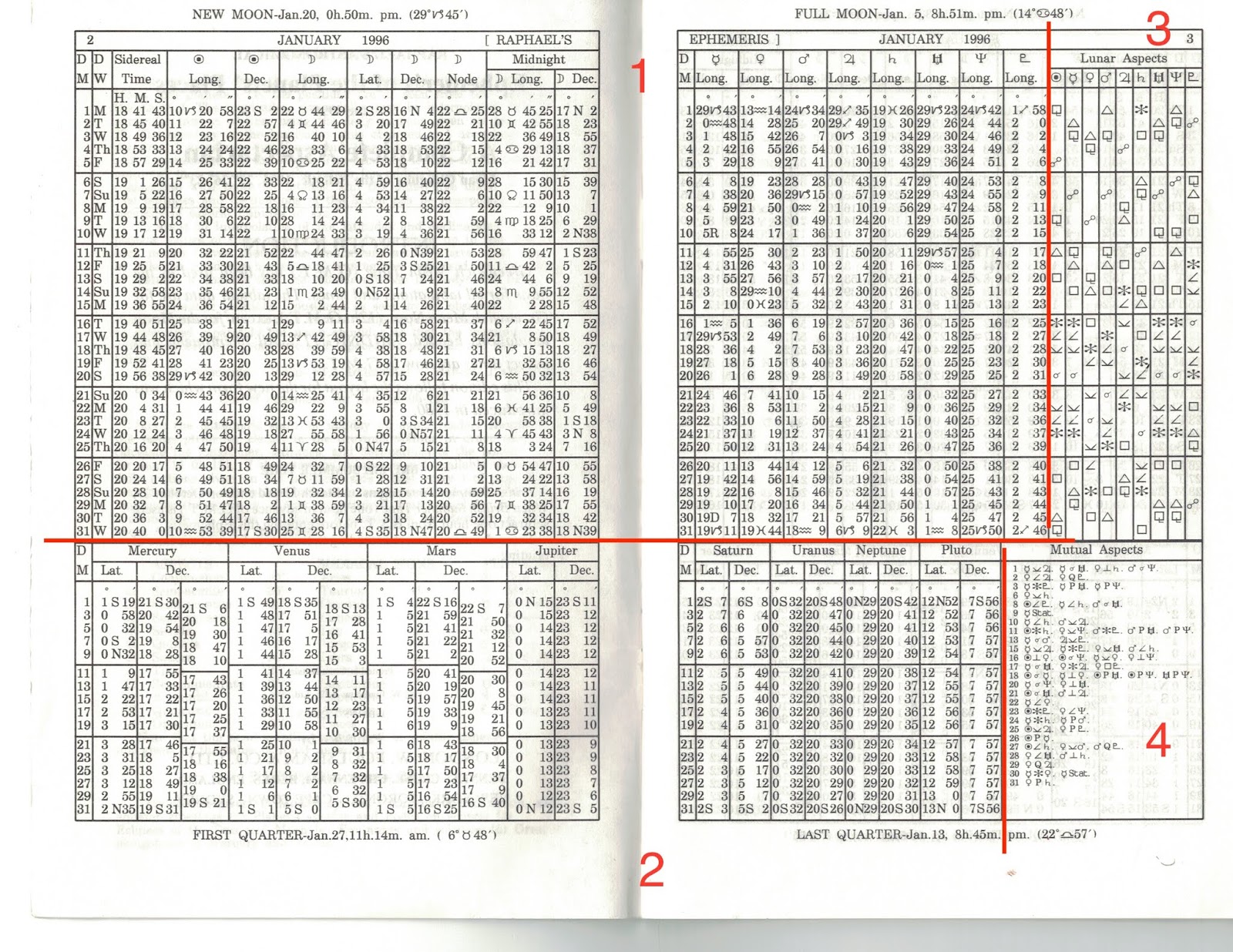
In this post I will be talking about the major English- language almanacs. I will start with one of the most extraordinary  ones: Raphael's ephemeris. For lack of a better word, this ephemeris is a complete anachronism. Almanacs with a similar format have been published since the 18th century. But because of this, Raphael's ephemeris is extraordinarily  suited for astrological work-- even more so than almost every other ephemeris.

1. The Monthly pages 

Two pages are dedicated for the planetary positions for each month. Here is the two-page spread, for of Jan 1996. The format is identical to the ones used today.


Each page can be divided into four sectors (see above) . In Sectors 1 and 2  we find the planet's positions. Sectors 3 and 4 show astrologically significant configurations of the planets.

Sector 1:

This contains planetary coordinates. The Left-hand page gives the following things, in order

  1. The Day of the month
  2. The Day of the week, both of which are self-explanatory
  3. The Sidereal Time: This is a measure of the earth's rotation. It is used to calculate house cusps. 
  4. The Sun's Longitude: This is the position of the sun in the Ecliptic, the  path the sun traces through the sky each year. For more on this, see http://www.medievalastrologyguide.com/the-zodiacs.html
  5. The Sun's Declination: This is how far above or below the sun is above the celestial equator. which is an imaginary band in the sky, used by astronomers as part of their coordinate system. 
  6. The Moon's Longitude: the position of the Moon in the Zodiac, 
  7. The Moon's [ecliptic] Latitude: This is how far above or how far below the Moon is from the Ecliptic. (BTW, The sun  has no ecliptic latitude, for he always travels on the ecliptic itself, never above or below it!)
  8. The Moon's Declination-- Like [5] but involving the moon
  9. The Moon's Node-- (The North Node) One of the points where the moon's path crosses the ecliptic. This is known as Rahu to the Indian astrologers, or Luohou 羅睺 To the Chinese.  It is astrologically significant point. The other point where the Moon's path crosses the ecliptic is the South node. This is always 180 degrees opposite the North Node; as a result there is no need to waste space with another column.
  10. The Moon's Logitude at 24H
  11. The Moon's Declination at 24H
These planetary positions are for GMT 1200H  every day. The exception are columns 10 and 11. These refer to the positions at "24h" each day, or in more normal terms, midnight the next day. For example, column 6 tells us the moon was in 22 Taurus on Midday 1 Jan. Column 10 tells us that 12 hours later -- i.e. midnight on the 2nd of January, she had moved to 2

 For an explication of ecliptic longitude, see: http://www.medievalastrologyguide.com/the-zodiacs.html

Reading that is fairly simple. So, we find the Sun's Longitude on Midday, New Year's day 1996 was 10 ♑(Capricorn) 20 (280°20' if you are using absolute Longitude like astronomers) and his declination was just over 23 degrees South. The Moon's Longitude was 22 ♉(Taurus)  40 (=52°40' if you are using absolute Longitude). 

Readers should note Raphael's ephemeris uses the tropical, rather than the Sidereal zodiac. However, if I recall correctly, their 50-year ephemeris  tabulates the ayanamsa each month. 

The exact method of converting between absolute longitude and longitude in terms of signs  is as follows: The whole ecliptic was divided into 12 equally-sized segments of 30 degrees each. Each of them is called a Sign.   


Symbol
Name
Absolute Longitude 
From
To
♈
Aries
0
29
♉
Taurus
30
59
♊
Gemini
60
89
♋
Cancer
90
119
♌
Leo
120
149
♍
Virgo
150
179
♎
Libra
180
209
♏
Scorpio
210
239
♐
Sagittarius
240
269
♑
Capricorn
270
299
♒
Aquarius
300
229
♓
Pisces
330
399

To use this table, add the degrees you see in the 'from' column to the minutes, and the result is absolute longitude. The converse is also true. 

So, for example, a planet that had a longtitude of 65°20'  would be expressed as  ♊ 5°20'. i.e. (2 x 30) + 5°20'.

However, it is now more common to place the sign's symbol between the degrees and minutes parts, thus:  5 ♊20, or 5 Gem 20, if you are in a text format. 

To give another example: Venus' Longtitude was 13 ♒14. This means it was in 13 degrees 14 minutes of Pisces. 

Absolute longditude of Pisces
330°00’
Add the number of degrees
  13°14’
Sum , or absolute longditude:
342°14’


The process can also be reversed.  So, for example, what is the position in terms of signs of a planet that has the longtitude of 109°45'?

1) 109 degrees falls within Cancer, (as cancer refers to a long. between 90 and 119°)
The given Longitude 
109°45'
Minus, the longitude of start of cancer: 
  90°00’
The position within Cancer itself 
19°45'

Thus 109°45'?  corresponds to 19 ♋45
A full tabulation  of correspondences can be found here: https://www.skyscript.co.uk/ablong.html 


***
I must stress that these 12 divisions have nothing to do with the constellations they have named after. They are wholly imaginary divisions of the ecliptic. For example, Spica, a star in the Constellation Virgo, has the ecliptic longitude of around 203 degrees-- which places it in the Sign of Libra.  

You may think this sounds absurd. Sidereal  astrologers would agree with you. these astrologers  'correct' to the ecliptic longitude, so the signs and constellations more closely correspond. I would outline this process in a later post. 

 On the other hand, some would argue that the 'correction' is unnecessary : There are legitimate astrological and astronomical reasons for using them. I will give one briefly. When the Sun is in the sign of Aries and Libra, the days and nights are of roughly equal length. The Sun in Capricorn would bring the longest nights of the year, and the Sun in Cancer would bring the shortest nights of the year (for the northern hemisphere at least. The Southern hemisphere, Cancer brings the longest nights and Capricorn the shortest) This correspondence is much distorted when you use the sidereal  zodiac. 

For more on this subject see http://www.medievalastrologyguide.com/the-zodiacs.html


***

Why are the planet's positions are charted for Midday rather than Midnight?  This harks back to the the 19th century. Back then, astronomers counted the day as starting from midday, rather than from midnight. Although astronomers switched to using Midnight [around 1925] the makers of the almanac retain the old system, perhaps through habit.

*** *** ***

Sector 2 shows the planet's latitude and Declination for the planets apart from the Sun and the Moon. In old editions of the almanac, Sector 2 is placed above the longitudes.


Latitude is the vertical distance from the Ecliptic; Declination the vertical distance from the equator.. Since the Sun travels exactly on the ecliptic (The ecliptic is by definition the Sun's path), it has no latitude, and is hence not tabulated. The Sun's declination is already tabulated in Sector 1, along with the Moon's latitude and declination.

For Jupiter, Saturn, Uranus, Neptune & Pluto, the declinations are calculated for every second day of the month. But for Mercury, Venus, and Mars, they are calculated for every day of the month.
The declinations for the three planets arranged in a curious manner. The declinations are split into two columns, which are staggered. The odd-numbered days are placed in one column; the even-numbered days are placed in a second column, with staggered lines.

So, Mercury's declination was
21°30' south on Jan 1st  (1st col. 1st row)
21
°06'  south on Jan 2nd (2nd col headed 'dec' 1st row)
20°42'  south on Jan 3rd (2nd col. 1st row)
etc etc etc 


*** *** *** 
Sector 3 shows the lunar aspects. This is the unique feature of the almanac. Raphael's is the only almanac that displays such data in a user-friendly manner.  So, for example, on January 1st we find that the Moon made a trine to Mars and Neptune, a Sextile to Saturn, and a sesquiquadrate (135 degrees) with the Sun.  Searching for aspects is also equally easy. If you wanted to find 'moon conjunct Jupiter' you run your finger down the column headed "♃"(= Jupiter)  until you get to the symbol for conjunction. (☌) (In this case the conjunction occurred on 18th Jan.) This is useful because Lunar aspects were traditionally used in selecting auspicious times for things.

Sector 4 the mutual aspects. Under this section are found aspects between the planets, as well as retrograde/direct stations.


So much for the planetary positions. However, what occurs after the planetary positions is more interesting; it will be added in a subsequent blog post