Part 1: Raphael’s Ephemeris
In this post I will be talking about the major English- language almanacs. I will start with one of the most extraordinary ones: Raphael's ephemeris. For lack of a better word, this ephemeris is a complete anachronism. Almanacs with a similar format have been published since the 18th century. But because of this, Raphael's ephemeris is extraordinarily suited for astrological work-- even more so than almost every other ephemeris.1. The Monthly pages
Two pages are dedicated for the planetary positions for each month. Here is the two-page spread, for of Jan 1996. The format is identical to the ones used today.
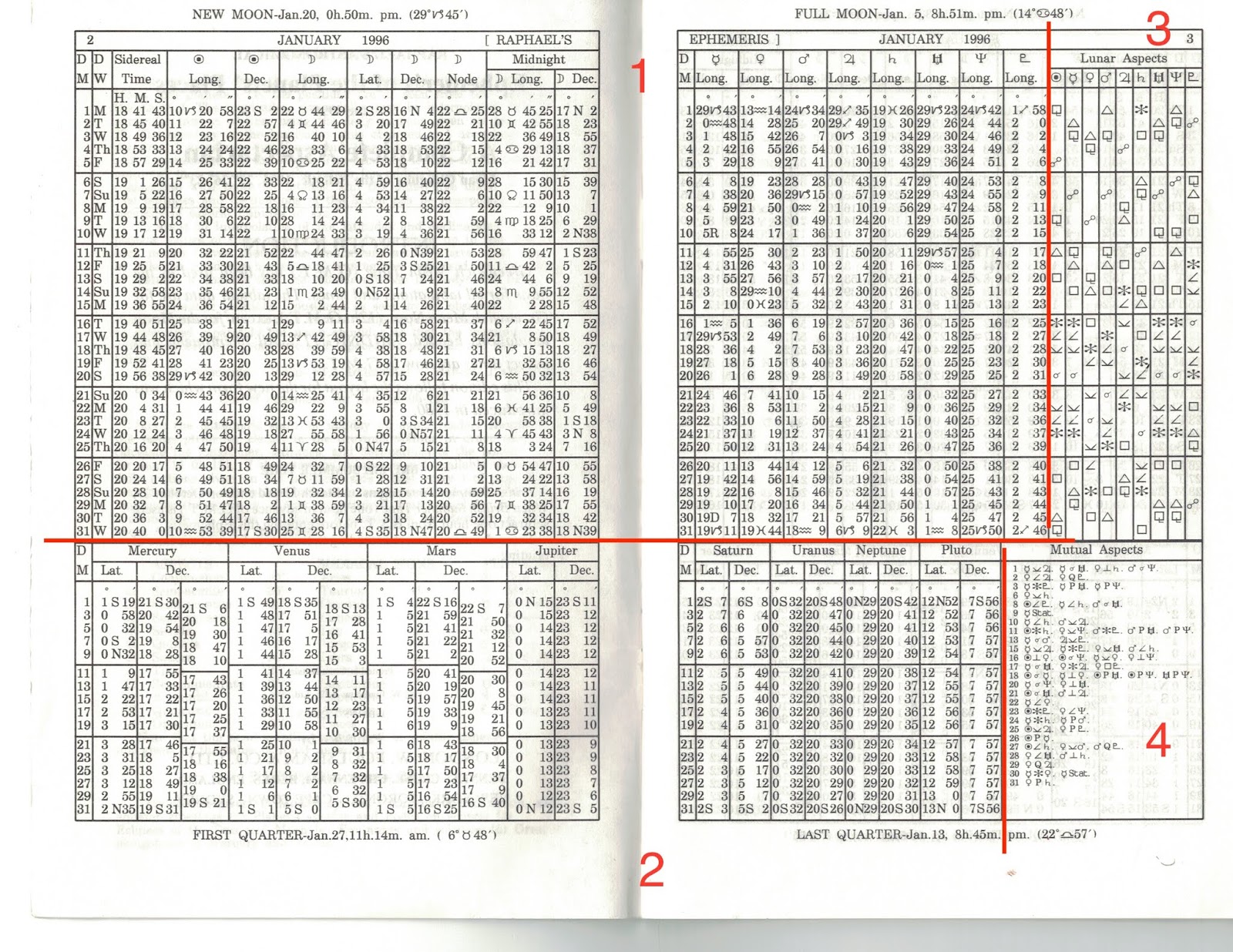
Each page can be divided into four sectors (see above) . In Sectors 1 and 2 we find the planet's positions. Sectors 3 and 4 show astrologically significant configurations of the planets.
Sector 1:
This contains planetary coordinates. The Left-hand page gives the following things, in order
- The Day of the month
- The Day of the week, both of which are self-explanatory
- The Sidereal Time: This is a measure of the earth's rotation. It is used to calculate house cusps.
- The Sun's Longitude: This is the position of the sun in the Ecliptic, the path the sun traces through the sky each year. For more on this, see http://www.medievalastrologyguide.com/the-zodiacs.html
- The Sun's Declination: This is how far above or below the sun is above the celestial equator. which is an imaginary band in the sky, used by astronomers as part of their coordinate system.
- The Moon's Longitude: the position of the Moon in the Zodiac,
- The Moon's [ecliptic] Latitude: This is how far above or how far below the Moon is from the Ecliptic. (BTW, The sun has no ecliptic latitude, for he always travels on the ecliptic itself, never above or below it!)
- The Moon's Declination-- Like [5] but involving the moon
- The Moon's Node-- (The North Node) One of the points where the moon's path crosses the ecliptic. This is known as Rahu to the Indian astrologers, or Luohou 羅睺 To the Chinese. It is astrologically significant point. The other point where the Moon's path crosses the ecliptic is the South node. This is always 180 degrees opposite the North Node; as a result there is no need to waste space with another column.
- The Moon's Logitude at 24H
- The Moon's Declination at 24H
For an explication of ecliptic longitude, see: http://www.medievalastrologyguide.com/the-zodiacs.html
Reading that is fairly simple. So, we find the Sun's Longitude on Midday, New Year's day 1996 was 10 ♑(Capricorn) 20 (280°20' if you are using absolute Longitude like astronomers) and his declination was just over 23 degrees South. The Moon's Longitude was 22 ♉(Taurus) 40 (=52°40' if you are using absolute Longitude).
Readers should note Raphael's ephemeris uses the tropical, rather than the Sidereal zodiac. However, if I recall correctly, their 50-year ephemeris tabulates the ayanamsa each month.
The exact method of converting between absolute longitude and longitude in terms of signs is as follows: The whole ecliptic was divided into 12 equally-sized segments of 30 degrees each. Each of them is called a Sign.
Symbol
|
Name
|
Absolute Longitude
|
|
From
|
To
|
||
♈
|
Aries
|
0
|
29
|
♉
|
Taurus
|
30
|
59
|
♊
|
Gemini
|
60
|
89
|
♋
|
Cancer
|
90
|
119
|
♌
|
Leo
|
120
|
149
|
♍
|
Virgo
|
150
|
179
|
♎
|
Libra
|
180
|
209
|
♏
|
Scorpio
|
210
|
239
|
♐
|
Sagittarius
|
240
|
269
|
♑
|
Capricorn
|
270
|
299
|
♒
|
Aquarius
|
300
|
229
|
♓
|
Pisces
|
330
|
399
|
To use this table, add the degrees you see in the 'from' column to the minutes, and the result is absolute longitude. The converse is also true.
So, for example, a planet that had a longtitude of 65°20' would be expressed as ♊ 5°20'. i.e. (2 x 30) + 5°20'.
However, it is now more common to place the sign's symbol between the degrees and minutes parts, thus: 5 ♊20, or 5 Gem 20, if you are in a text format.
To give another example: Venus' Longtitude was 13 ♒14. This means it was in 13 degrees 14 minutes of Pisces.
Absolute longditude of Pisces
|
330°00’
|
Add the number of degrees
|
13°14’
|
Sum , or absolute longditude:
|
342°14’
|
The process can also be reversed. So, for example, what is the position in terms of signs of a planet that has the longtitude of 109°45'?
1) 109 degrees falls within Cancer, (as cancer refers to a long. between 90 and 119°)
The given Longitude
|
109°45'
|
Minus, the longitude of start of cancer:
|
90°00’
|
The position within Cancer itself
|
19°45'
|
Thus 109°45'? corresponds to 19 ♋45
A full tabulation of correspondences can be found here: https://www.skyscript.co.uk/ablong.html
***
You may think this sounds absurd. Sidereal astrologers would agree with you. these astrologers 'correct' to the ecliptic longitude, so the signs and constellations more closely correspond. I would outline this process in a later post.
On the other hand, some would argue that the 'correction' is unnecessary : There are legitimate astrological and astronomical reasons for using them. I will give one briefly. When the Sun is in the sign of Aries and Libra, the days and nights are of roughly equal length. The Sun in Capricorn would bring the longest nights of the year, and the Sun in Cancer would bring the shortest nights of the year (for the northern hemisphere at least. The Southern hemisphere, Cancer brings the longest nights and Capricorn the shortest) This correspondence is much distorted when you use the sidereal zodiac.
For more on this subject see http://www.medievalastrologyguide.com/the-zodiacs.html
***
Why are the planet's positions are charted for Midday rather than Midnight? This harks back to the the 19th century. Back then, astronomers counted the day as starting from midday, rather than from midnight. Although astronomers switched to using Midnight [around 1925] the makers of the almanac retain the old system, perhaps through habit.
*** *** ***
Sector 2 shows the planet's latitude and Declination for the planets apart from the Sun and the Moon. In old editions of the almanac, Sector 2 is placed above the longitudes.
Latitude is the vertical distance from the Ecliptic; Declination the vertical distance from the equator.. Since the Sun travels exactly on the ecliptic (The ecliptic is by definition the Sun's path), it has no latitude, and is hence not tabulated. The Sun's declination is already tabulated in Sector 1, along with the Moon's latitude and declination.
For Jupiter, Saturn, Uranus, Neptune & Pluto, the declinations are calculated for every second day of the month. But for Mercury, Venus, and Mars, they are calculated for every day of the month.
The declinations for the three planets arranged in a curious manner. The declinations are split into two columns, which are staggered. The odd-numbered days are placed in one column; the even-numbered days are placed in a second column, with staggered lines.
So, Mercury's declination was
21°30' south on Jan 1st (1st col. 1st row)
21°06' south on Jan 2nd (2nd col headed 'dec' 1st row)
20°42' south on Jan 3rd (2nd col. 1st row)
etc etc etc
*** *** ***
Sector 3 shows the lunar aspects. This is the unique feature of the almanac. Raphael's is the only almanac that displays such data in a user-friendly manner. So, for example, on January 1st we find that the Moon made a trine to Mars and Neptune, a Sextile to Saturn, and a sesquiquadrate (135 degrees) with the Sun. Searching for aspects is also equally easy. If you wanted to find 'moon conjunct Jupiter' you run your finger down the column headed "♃"(= Jupiter) until you get to the symbol for conjunction. (☌) (In this case the conjunction occurred on 18th Jan.) This is useful because Lunar aspects were traditionally used in selecting auspicious times for things.Sector 4 the mutual aspects. Under this section are found aspects between the planets, as well as retrograde/direct stations.
So much for the planetary positions. However, what occurs after the planetary positions is more interesting; it will be added in a subsequent blog post


